Benchmarks for Testing the Software

Testing this software is needed to see how it performs under real world conditions and to meet the ends needed for the user. Because of the importance of the findings and data collection, this cannot be written off and testing in theory, but they must undergo various real world stress test to ensure the systems do not buckle or fail. Where there are inconsistencies or discrepancies in the statistical information handling, there must be maintenance functions or safeguards to ensure the errors can be fixed and the system can continue.
These statistical software must handle vast amounts of data, often integrating them into complex mathematical functions and models, and making repeated estimations based on those margins. Consistency is key to robust statistical software, as is the data collection management, computational efficiency, and the ability to perform at high speed, for real-time applications.
Computational Speed
Financial and econometric models require fast computation speed to handle large volumes of data in limited periods of time. In many real world examples, data collection is time sensitive, and projecting any estimations or monitoring macroeconomic variables can change quickly, requiring software that can track and adapt to these fluctuations or volatility in those strict timeframes. Performing under these time pressures is essential. At any given time, the software may need to process millions of rows of data, or run thousands of simulations with real-time figures to generate estimation distribution models.
Benchmarking these helps compare different statistical software for their speed, showing how well the software is equipped for meeting specific demands. One system may be better at regression analysis, but struggle to produce large simulation workloads. By knowing these strengths and weaknesses, the software can be assigned to its best real world financial environment.
Speed in Calculating Regressions and Estimations
Regression outputs, using methods like the Maximum Likelihood Estimation, Probit or Logit models, are important for projecting probability distributions and analyzing historical data to explain any errors or distinct entries. Statistical software that can accommodate these complex models, simulate them in real-time, and run without any delays are highly valuable. This allows researchers to tweak and refine the models continuously, or add new data variables to keep the models up to date.
Examples of Real-Time System Requirements
The need for computational speed becomes most apparent when there is little to no room for delay in real world conditions. For instance, for algorithmic trading, where forecasts must be accurate, constantly soaking up the latest inputs, and creating simulations for the user, even seconds of delay can render the outcomes ineffective. In risk monitoring systems, where data streams are virtually continuous and impacted by many external and often unpredictable data inputs, the system must be flexible and capable of accommodating these, filtering and sending the data to the appropriate models, and generating the desired outcomes for the analysts.
Matrix Operations
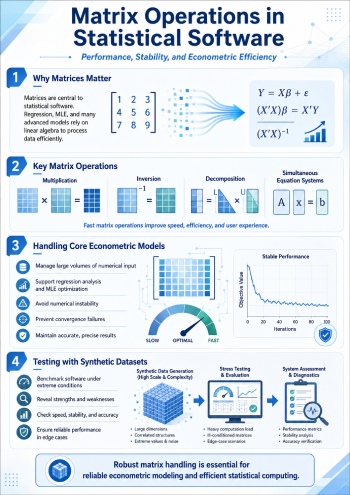
Matrixes are central to the operation of a statistical software. Virtually all models, including regression systems to the complex MLE models, use linear algebra that requires matrixes to process. The statistical software must be capable in handling the data, distributing it appropriately across the matrixes, and then handling mathematical matrix operations. The faster the system can do this, the more efficient it is for the user. g can also involve pushing the software to its limits, checking how it functions under these conditions, and whether this impacts the speed, accuracy, and efficiency of the matrix operation.
The operations in question involve matrix multiplication, inversion, decomposition and handling matrix systems that involve simultaneous equations. For its given purpose, the matrix operations must be able to handle larger volumes of numerical inputs, without slowing down, avoiding numerical instability, and preventing any convergence in the estimation models to keep a clean and precise outcome.
Handling Core Econometric Models
Matrices can reach enormous sizes with ever flowing streams of data logging into the system at any given time. The operating system must be able to invert these matrices, solving equations, performing multiplications and handling the metrics without exceeding the limits or creating an instability in the outcomes. Common failures here include inaccurate results, or an inability to converge complex models, making distortions that can be misinterpreted.
Especially where entries have variance, and estimation requires complex systems to handle for this, or accommodate any errors that could impact the results. Allocating data, handling the different matrix operations for regression analysis or MLE optimization, is key to a robust core econometric model.
Usability for Testing Synthetic Datasets
Test benchmarking matrix operations often include synthetic datasets. This is a test of the system under extreme conditions, pushing the software to the limits of its capabilities. This gives researchers the data they need to evaluate whether the software maintains stability under unrealistic but informative edge cases.
Edge cases are not the primary intended use for these systems, but knowing they can still operate without creating errors or overloading in these scenarios ensures that the software is fully equipped for the user's needs. Again, there are software systems that work better for specific use cases, and have weaknesses in other areas. Learning these can only be done through synthetic databases specially designed to find these strengths and weaknesses.
Memory Handling
Different applications have their own memory requirements, but for the econometrics or financial research that have millions of inputs across hundreds, or even thousands of variables, the system must be fault proof. Competent software systems can handle memory efficiently, without erroneously allocating it to the wrong operation, ignoring specific datasets, or risking instability.
The benchmark testing here is on how much RAM the software consumes in performance. It also involves testing how the system behaves when it reaches the hardware limits, and how long it can maintain these high stress environments while still performing as they should. The advanced platforms can incorporate advanced memory handling techniques to avoid any of the unwanted negative impacts. These include compressing storage, chunk processing, or on-disk computation, all of which help reduce the stress on the core system.
Functionality When Memory Limits are Exceeded
Knowing the statistical software behavioral patterns once memory limits are reached is vital to understanding where it is best applied. Large datasets and repeated simulations can quickly overwhelm weaker systems, causing crashes, freezes, or incomplete calculations. Advanced software avoids this by using compressed storage, chunk processing, or shifting workloads onto disk storage rather than RAM.
These safeguards allow the system to continue operating without losing datasets or corrupting the outcomes. This is key to users who work in financial research environments where handling continuous streams data is a necessity in real time.
Optimizing for Scalability
In econometrics, scalability is one of the most valuable assets at research level and for corporate uses. Scalability measures whether the software can maintain performance as datasets and models grow larger. These systems must be flexible and adaptable to take on larger volumes of data, all while providing the functions needed to tailor the models to suit the needs of the user.
Many systems perform well on small workloads but slow down significantly when more variables or simulations are added. Benchmark testing evaluates whether computational speed, memory handling, and numerical accuracy remain stable under increasing pressure. Scalable software is essential in econometrics because financial databases constantly expand with new market information, historical records, and live inputs.
Multi-Core Processing
Most of the econometric operations are too complex and demanding for a single processing thread. Which is why modern statistical software generally uses multi-core processors, reducing the potential execution time and running simulations or larger calculation operations without burdening effort. The software must distribute the workload across the various CPU cores, a system that has to be calibrated to create the best efficient workflow and reduce overloading or exceeding a limit at any step of the way.
Multi-core processing is a must for simulation-based operations, and to achieve accuracy and speed in these estimation methods, a technique called parallelization is required. This is a system where many computational tasks are segmented into sub-tasks, so that they can be handled simultaneously and across multiple CPU cores. It is a core driver of computational speed and high performance computing.
Complex Estimations in Simulations
Simulation heavy systems require enormous computational power because they repeatedly estimate thousands or millions of possible outcomes. Multi-core processing allows these workloads to be distributed across several processor cores simultaneously. They can then be plugged into the matrices, solved by the software, and converted into outcomes for the user.
Using multiple cores dramatically reduces execution times for systems like Monte Carlo simulations, portfolio optimization models, or MLE estimation methods. It is used in most modern systems, and without multi-core support, these calculations can become too slow for real time financial analysis or forecasting environments, severely impacting the usability and efficiency of the software.
Importance in Parallelization Architecture
Parallelization architecture determines how efficiently statistical software distributes workloads across multiple CPU cores. It has to break down the processes into tasks that can be executed by different cores at the same time, without creating overlaps or errors that can compound during convergence. Well optimized systems balance the tasks evenly, preventing bottlenecks or overloaded processor threads. This is a vitally important requirement when several simulations or forecasting models are running simultaneously.
Benchmark testing checks whether performance improves as more cores are introduced, ensuring the software can fully utilize modern high performance computing systems. This also lends to the potential for scalability within the system. For if the workloads are well distributed and clearly manageable, the system can take on larger volumes of data and testing for more difficult or demanding tasks can occur. It all pivots on a well distributed parallelization technical infrastructure.
Numerical Accuracy in Large Models
Numerical inputs and observed data can be extremely sensitive and even the finest of errors can distort the results or create major discrepancies in a model. While it may be a handful of errors in a dataset that contains millions of logged data points, these can compound and create major distortions in the larger econometric models. Therefore, numerical accuracy is one of the most important benchmarks when testing statistical software. In financial research where large input volumes are required for estimating probabilities or simulating outcomes, even minor rounding or data exclusion taints the results and risks ruining the output.
That is not to say these are impossible. Floating-point stability is an issue where decimal values cannot be represented perfectly, which causes rounding errors to appear in calculations. Over the course of thousands of iterations, these errors can compound and enhance, altering the results significantly at the end. Which is why a focus on reproducibility is also important. As this demands the statistical software recalculate the data with the same inputs and test the outcomes. Any inconsistencies indicate an instability or weakness in the estimation operation of the system.
Rounding Errors and Foating-Point Stability
Floating-point stability measures how well software handles the small numerical approximations created during repeated calculations. Tiny rounding errors can occur, however unwanted. The goal is to not allow these to build up, as they compound across the various processes and equations and can result in big distortions in the outcomes, or disproportionate impacts from random data points.
This is particularly dangerous in econometric modeling, where probability estimations and simulations rely on extremely precise calculations. While in some cases, floating-point stability is nearly unavoidable, the more advanced systems are better suited to these discrepancies. Stable software minimizes these distortions and maintains consistency throughout the estimation process.
Estimation Methods and Reproducibility
Reproducibility ensures that the same dataset and model specifications consistently produce identical outputs. Benchmark testing checks whether the software remains stable across repeated calculations and different operating conditions. Inconsistent results may indicate weaknesses in the estimation algorithms or the numerical processing system.
Reliable reproducibility is essential in financial research, regulatory auditing, and academic econometrics, where conclusions must remain verifiable and defensible. This way, the statistical software does not have instability or any fundamental issues that can create otherwise unreliable results. The outcomes are provable through reproducibility, and thus more trustworthy for the user.